What is Farcaster Sync?
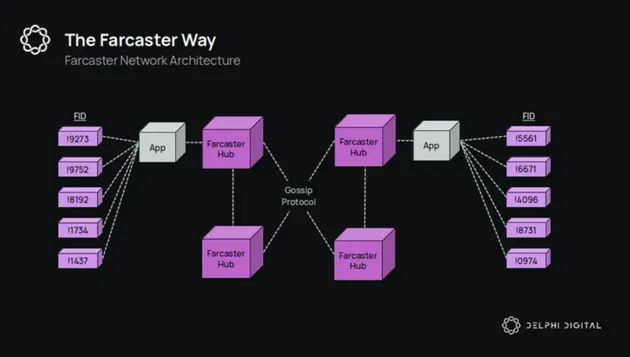
Farcaster Sync is the backbone of the network's decentralization. It is the mechanism by which independent hub operators exchange messages—casts, reactions, and profile updates—to ensure every node maintains a consistent view of the social graph. Unlike centralized platforms where a single server dictates truth, Farcaster relies on a gossip protocol where hubs communicate directly with one another.
When you post a message, it lands on your chosen hub. That hub then propagates the message to its peers. This propagation continues until the message has reached a sufficient percentage of the network, ensuring redundancy and resistance to censorship. The health of the network depends on this synchronization; if a hub falls behind, it may miss recent context or fail to display new content accurately.
This architecture separates onchain identity from offchain data storage. Your identity is anchored on-chain (typically on Base), but the actual content lives in the distributed hub network. This design allows for a resilient, open social layer where infrastructure providers compete on reliability and speed, rather than controlling the narrative.
For builders and investors, understanding sync is critical. A hub that is online but not syncing effectively is functionally offline. Monitoring sync percentages and hub connectivity is the primary way to assess the true health and decentralization of the Farcaster ecosystem.
Hub Infrastructure and Sync Mechanics
Running a Farcaster hub is less about high-frequency trading infrastructure and more about reliable data persistence. Hubs are the backbone of the network, storing casts, reactions, and follow lists. They communicate via a gossip protocol to share updates, but because this is a peer-to-peer network, no single hub is the source of truth. Instead, clients aggregate data from multiple hubs to ensure redundancy. If a hub goes offline, the data remains available on its peers, but the operator loses access to their local snapshot until they resync.
Server Specs and Storage
The hardware requirements for a hub are modest compared to an Ethereum full node, but they demand consistent uptime and fast I/O. You can run a hub on a basic VPS with 2 CPU cores and 4GB of RAM. The primary constraint is storage, which grows linearly with the age of the network. As of early 2024, a fresh sync takes roughly 50-70GB of disk space, but this will expand as more data is cast. Use an SSD; spinning disks will cause significant lag during the initial sync and when handling bursts of traffic. For most builders, a $20-30/month VPS from providers like DigitalOcean or Hetzner is sufficient to start.
Understanding Sync Percentage
The most critical metric for hub operators is the sync percentage. This number tells you how much of the network’s data your hub has downloaded and verified. A sync percentage of 100% means your hub is fully up to date with the network. However, a hub can be "online" while sitting at 85% sync if it started recently or experienced a brief outage. Clients typically query multiple hubs; if your hub is lagging, clients may still resolve data from other peers, but your hub’s utility for real-time applications diminishes. Regularly monitoring this metric via the hub’s API is essential for maintaining a healthy node.
Infrastructure Costs and Market Context
Running a hub is a low-cost operation, but it requires attention to detail. The primary expense is the monthly VPS fee and the data transfer costs if you serve heavy traffic. Unlike trading infrastructure, where latency is measured in microseconds, hub infrastructure prioritizes data integrity and availability. To contextualize the broader market environment in which these infrastructure costs exist, consider the performance of the underlying Ethereum network, which hosts the onchain identity contracts.
Market research and hub economics
Running a Farcaster hub is less about passive hosting and more about managing infrastructure costs against protocol incentives. The economics revolve around three variables: server uptime, bandwidth for the gossip protocol, and the value of the onchain identity you help secure. For builders, this means choosing between self-hosting for maximum control or using managed providers for reliability.
To understand the baseline cost of running this infrastructure, we look at the underlying Layer 2 network. Since most Farcaster hubs operate on Optimism or Base, the cost of state storage and transaction fees is tied directly to the L2 token's market performance.
The choice of hub provider dictates your risk profile and sync percentage. Managed services offer higher reliability but take a cut of any potential future incentives, while self-hosted hubs require you to handle scaling issues during network congestion. The table below compares the typical trade-offs for the two primary approaches.
| Option | Control | Cost | Sync Reliability |
|---|---|---|---|
| Self-Hosted | High | Low (Infra only) | Variable |
| Managed (e.g., Neynar) | Low | Medium | High |
| Managed (e.g., Farcaster Hub) | Medium | Medium | High |
For investors and long-term holders, the decision often hinges on whether they believe hub operators will receive direct protocol rewards. Currently, most incentives are indirect, tied to the growth of the Farcaster ecosystem rather than direct payments to hub runners. This means the primary motivation for many is supporting the network's decentralization, rather than immediate financial return.
Strategy for Builders and Users
Building on Farcaster requires understanding the sync percentage between hubs before committing to one. Unlike centralized platforms, no single hub holds the full truth. Data integrity depends on how well your chosen hub gossips with the network. For builders, this means designing for eventual consistency. For users, it means checking if your client is actually up to date with the latest casts.
1. Verify Hub Sync Status
Before integrating, check the sync percentage of your target hub. A hub stuck at 90% sync might miss recent context or fail to render new frames correctly. Use official documentation to understand how to query hub health endpoints. This step ensures your application doesn’t serve stale data to users who expect real-time updates.
2. Implement Standard Web App Migration
If you are migrating legacy mini-apps, follow the Base documentation to adopt standard web app patterns. Deprecated SDK methods can break frame interactions or identity verification. Registering on Base.dev ensures your app complies with current security standards and maintains compatibility with the broader Farcaster ecosystem.
3. Secure Onchain Identity with Sign-In
Trust starts with identity. Implement "Sign in with Farcaster" (SIWF) to verify user ownership without exposing private keys. This process involves showing a sign-in button, waiting for the user to scan a QR code, and verifying the resulting signature. This onchain identity layer is critical for builders who need to prevent sybil attacks or ensure unique user counts.
4. Choose Clients Based on Data Integrity
Users should select clients that prioritize data integrity over flashy UI features. A client that doesn’t sync properly with multiple hubs will give you a fragmented view of the network. Look for clients that explicitly state their hub connections and sync rates. This transparency helps you avoid echo chambers and ensures you see the full breadth of conversations.
| Feature | Builder Priority | User Priority |
|---|---|---|
| Sync Percentage | High: Determines data freshness | High: Determines content completeness |
| Hub Diversity | High: Reduces single point of failure | Medium: Affects view breadth |
| SDK Stability | Critical: Prevents runtime errors | Low: Handled by client |
Common farcaster: what to check next
Navigating the decentralized social landscape requires understanding how your data moves and interacts. This section addresses the most frequent technical queries regarding scanning, messaging, and channel creation.
These mechanisms ensure that your Farcaster Sync guide implementation remains secure and user-friendly while leveraging the protocol's decentralized architecture.
No comments yet. Be the first to share your thoughts!